10 desembre 2010
SYNOPSIS
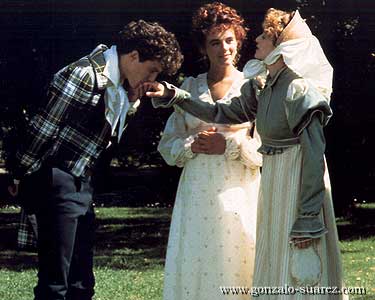
The events that led Mary Wollstonecraft Shelley to write her horror masterpiece -Frankenstein provide the basis of this haunting, romantic drama. The story opens aboard a beat up schooner as it carefully makes its way through a massive broken ice pack near the North Pole. There Shelley writes her fantastic tale and reminisces about the events of the previous summer when she was courted by the poetic Percy Byshe Shelley. They elope and go to Switzerland where they become friends with dashing Lord Byron and his companion Dr. Polidori. Shelley’s sister Claire accompanies them and gets romantically entangled with Byron. The group subsequently spends some idyllic almost hedonistic weeks at Byron’s villa. Over the next few years, strange, tragic and troubling events occur and whenever they do, Shelley sees her monster lurking in the shadows. Sandra Brennan, Rovi
Rowing with the Wind or «Remando al Viento», this film gives to us a clear thought about the mechanisms of the creative process and the poetic relationship between Byron and The Shelleys.
Weblography.
- Página Oficial ,Gonzalo Suarez, Rowing with the Wind. Dirección URL: http://www.clubcultura.com/clubcine/clubcineastas/suarez/1peliviento.htm
- Star Pulse ( Your Entertainment Destination), Synopsis Rowing with the Wind by Sandra Brennan, Rovi. Dirección URL: http://www.starpulse.com/Movies/Rowing_with_the_Wind-V140627/Summary/
- Wikipedia, Rowing with the Wind. Dirección URL: http://en.wikipedia.org/wiki/Rowing_with_the_Wind
- IMDb ( The Internet Movie Database), Trailer Rowing with the Wind. Dirección URL: http://www.imdb.com/video/screenplay/vi1473053465/
CREATIVE PROCESS
At the beginning of the film, Lord Byron starts with a poem called: «Darkness».
I had a dream, which was not all a dream.
The bright sun was extinguish’d, and the stars
Did wander darkling in the eternal space,
Rayless, and pathless, and the icy earth
Swung blind and blackening in the moonless air;
Morn came and went — and came, and brought no day,
And men forgot their passions in the dread
Of this their desolation; and all hearts
Were chill’d into a selfish prayer for light:
And they did live by watchfires — and the thrones,
The palaces of crownded kings — the huts,
The habitations of all things which dwell,
Were burnt for beacons; cities were consumed,
And men were gather’d round their blazing homes
To look once more into each other’s face;
Happy were those who dwelt within the eye
Of the volcanos, and their mountain-torch:
A fearful hope was all the world contain’d;
Forests were set on fire — but hour by hour
They fell and faded — and the crackling trunks
Extinguish’d with a crash — and all was black.
The brows of men by the despairing light
Wore an unearthly aspect, as by fits
The flashes fell upon them; some lay down
And hid their eyes and wept; and some did rest
Their chins upon their clenched hands, and smiled;
And others hurried to and fro, and fed
Their funeral piles with fuel, and look’d up
With mad disquietude on the dull sky,
The pall of a past world; and then again
With curses cast them down upon the dust,
And gnash’d their teeth and howl’d: the wild birds shriek’d
And, terrified, did flutter on the ground,
And flap their useless wings; the wildest brutes
Came tame and tremulous; and vipers crawl’d
And twined themselves among the multitude,
Hissing, but stingless — they were slain for food
And War, which for a moment was no more,
Did glut himself again: — a meal was bought
With blood, and each sate sullenly apart
Gorging himself in gloom: no love was left;
All earth was but one thought — and that was death
Immediate and inglorious; and the pang
Of famine fed upon all entrails — men
Died, and their bones were tombless as their flesh;
The meagre by the meagre were devour’d,
Even dogs assail’d their masters, all save one,
And he was faithful to a corse, and kept
The birds and beast and famish’d men at bay,
Till hunger clung them, or the dropping dead
Lured their lank jaws; himself sought out no food,
But with a piteous and perpetual moan,
And a quick desolate cry, licking the hand
Which answer’d not a caress — he died.
The crowd was famish’d by degrees; but two
Of an enormous city did survive,
And they were enemies: they met beside
The dying embers of an altar-place
Where had been heap’d a mass of holy things
For an unholy usage; they raked up,
And shivering scraped with their cold skeleton hands
The feeble ashes, and their feeble breath
Blew for a little life, and made a flame
Which was a mockery; then they lifted up
Their eyes as it grew lighter, and beheld
Each others aspects — saw, and shriek’d, and died —
Even of their mutual hideousness they died,
Unknowing who he was upon whose brow
Famine had written Fiend. The world was void,
The populous and the powerful was a lump
Seasonless, herbless, treeless, manless, lifeless,
A lump of death — a chaos of hard clay.
The rivers, lakes, and oceans all stood still,
And nothing stirr’d within their silent depths;
Ships sailorless lay rotting on the sea,
And their masts fell down piecemeal: as they dropp’d
They slept on the abyss without a surge —
The waves were dead; the tides were in their grave,
The moon, their mistress, had expired before;
The winds were wither’d in the stagnant air,
And the clouds perish’d; Darkness had no need
Of air from them — She was the Universe.
This poem has a clear historical context: the Mount Tambora had erupted in the Dutch East Indies the previous year, casting enough ash in to the atmosphere to block out the sun and cause abnormal weather across much of northeast America and northern Europe. This pall of darkness inspired Byron to write his poem.
Also, different biblical images are exposed. The Apocaplyse, as a prophet with a duty to warn others about their impending doom. Byron is communicating that fear: that God is not in nature or in us; that he is not at all; that “Darkness [or nature] had no need / of aid from them—She was the universe.
Or when he says: Evil exists in itself, and it is called Sin.
Despite the fact of being very criticised by people, egocentric (He thought that the Earth was created in his Honour), love scandals and a vast list of affairs, he became one of the greatest Poets of his time.
After having had a discussion about Men and Reality with Percy, Mary, Polidori in Switzerland on their way to Italy, he suggests that it would be a fantastic idea to invent a ghost story to show that reality is always more terrible.
«I think that men are a terrible invention. The horror will remain forever».
Due to this idea, Mary starts to explore her fears and translate them into the creation of a story, «Frankestein». The Monster she had created, gets away from her, getting an independent life.
To conclude this part, I can not forget talking about Polidori, Byron’s assistant, situated on a degradated step comparing to Byron. It is clear the Byron’s elitism and his influence over him.
Weblography.
- Readytogoebooks, List of Lord Byron’s Poems, Darkness. Dirección URL: http://www.readytogoebooks.com/Lb-Drk85.htm
- Wikipedia, John William Polidori. Dirección URL: http://en.wikipedia.org/wiki/John_William_Polidori
PERCY & MARY SHELLEY IN CONTRAST TO BYRON
Two different ways of life which are reflected in their plays. Byron is an adventurer, arrogant, sarcastic, meanwhile The Shelleys are more introspective, patient, humble. Byron has answers for everything but the Shelleys are always placed in an endless question.